Agentic commerce: hype or hard reality?
Marco Flapper | 13-05-2026
You have probably seen the term pop up everywhere. In whitepapers, on LinkedIn, at conferences: agentic commerce. And as tends to happen with these kinds of terms, everyone is talking about it, but when you ask what it actually means, the answers get vague.
Understandable. Because agentic commerce is simultaneously very concrete and still largely under development. Forrester, one of the most authoritative research firms in digital business, puts it plainly: agentic commerce “only sort of exists.” And yet Amazon, Walmart, Google, Mastercard and dozens of other major players are investing massively in it right now.
So what exactly is it? Should you be doing something about it already? And if you are not, are you falling behind? This article gives you an honest and clear overview, without buzzwords and without panic.
What makes something ‘agentic’?
Artificial intelligence is not a monolithic concept. Under the broad AI umbrella sit several distinct layers.
Machine learning learns from data and makes predictions. Deep learning recognises complex patterns in speech, images and text. Generative AI, the technology behind ChatGPT, creates new content based on everything it has previously seen. Agentic AI adds something fundamental on top of that: autonomous action. An agentic system sets its own goals, makes decisions and carries out actions, without a human needing to approve every step.
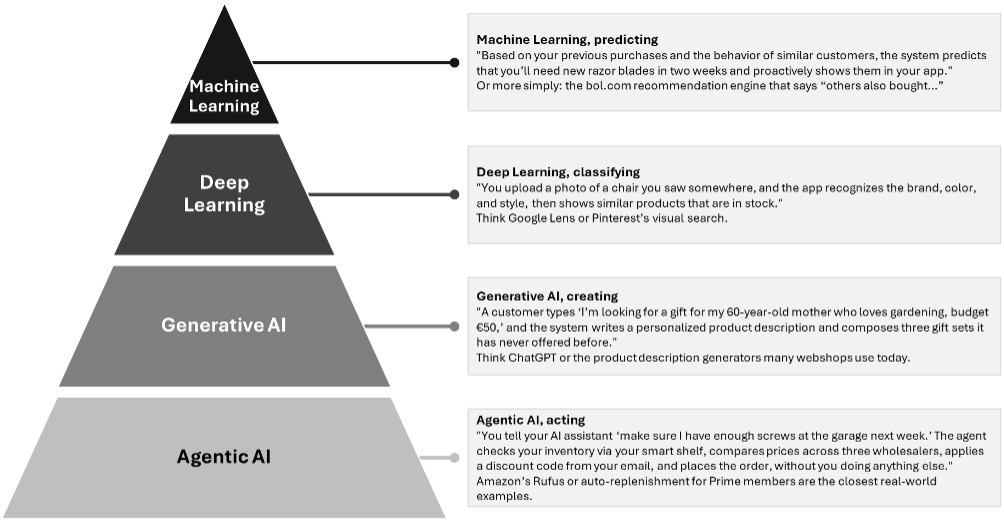
The crucial difference is therefore not what the AI knows or can create, but what the AI does. A chatbot that answers questions? Not agentic. An AI that independently compares products, negotiates a discount and places an order? That is agentic.
So what exactly is agentic commerce?
Agentic commerce is the model in which AI agents independently carry out actions throughout the purchasing process, on behalf of consumers, businesses, or both.
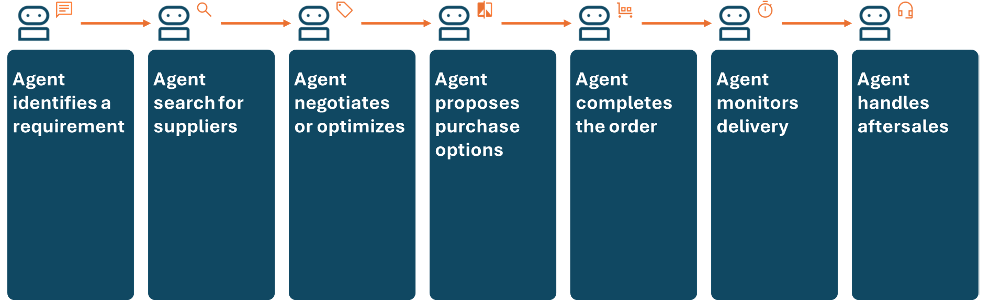
Consider this scenario: you tell your AI assistant ‘Find me the best laptop for video editing under $1,500, with fast delivery.’ By the time your coffee is ready, the agent has compared hundreds of options, analysed reviews, checked availability and placed the order. You have not visited a single website.
This is the essence of agentic commerce. Not a smarter search bar. Not a chatbot that redirects you to a FAQ. A system that understands your intent and handles everything from start to finish.
What is already happening in practice?
Full agentic commerce, where an AI agent completes a purchase entirely on its own, is still the exception rather than the rule. But the movement is unmistakable:
- Walmart launched an integration with ChatGPT allowing shoppers to search for products, build a basket and check out directly in the chat.
- Amazon’s AI assistant Rufus drove purchase sessions during Black Friday that surged 100% compared to trailing averages, with daily conversion increasing 75% year on year.
- Google introduced AI Mode, an experience that helps shoppers find inspiration and buy at the right moment.
- Mastercard’s Agent Pay completed its first agentic transaction outside the US in late 2025.
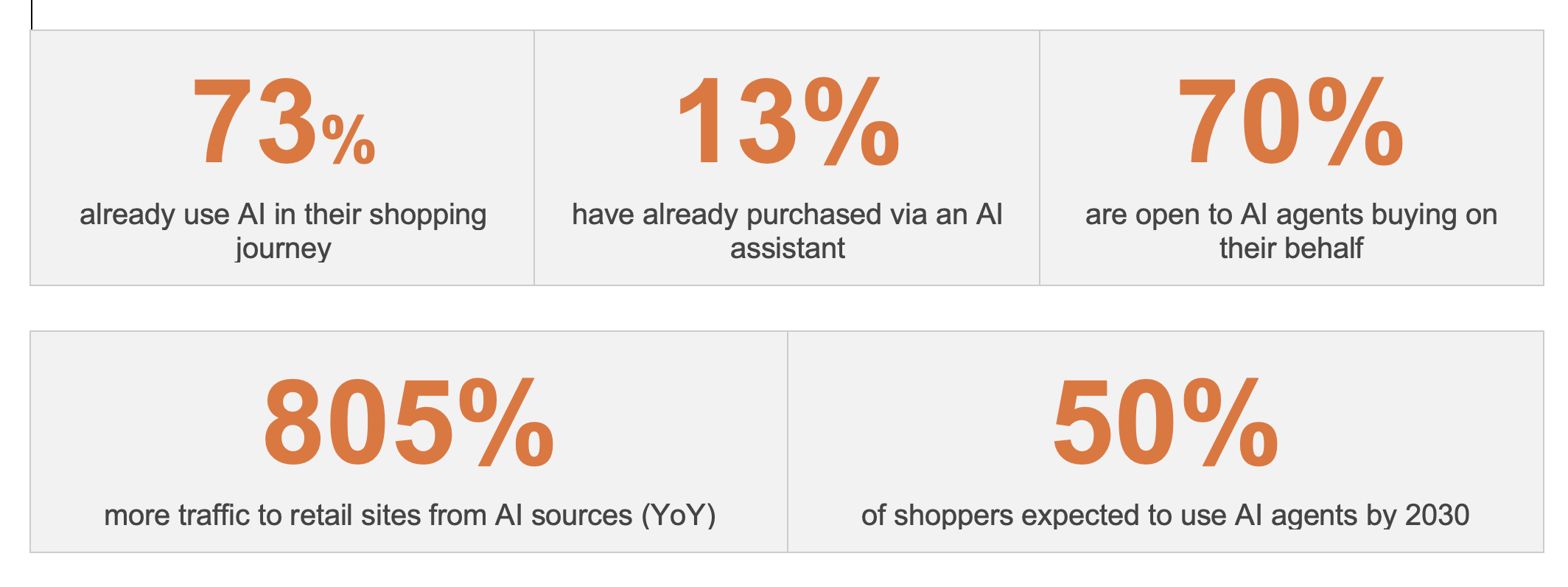
These are no longer proof-of-concepts. These are live services, at the world’s largest retailers. Yet only 13% of consumers say they have already completed a purchase via an AI assistant. But 70% say they are at least somewhat comfortable with the idea of an AI agent making purchases on their behalf. Adoption is growing fast.
Two worlds: owned and non-owned
An important distinction that many people overlook: agentic commerce plays out in two fundamentally different environments.
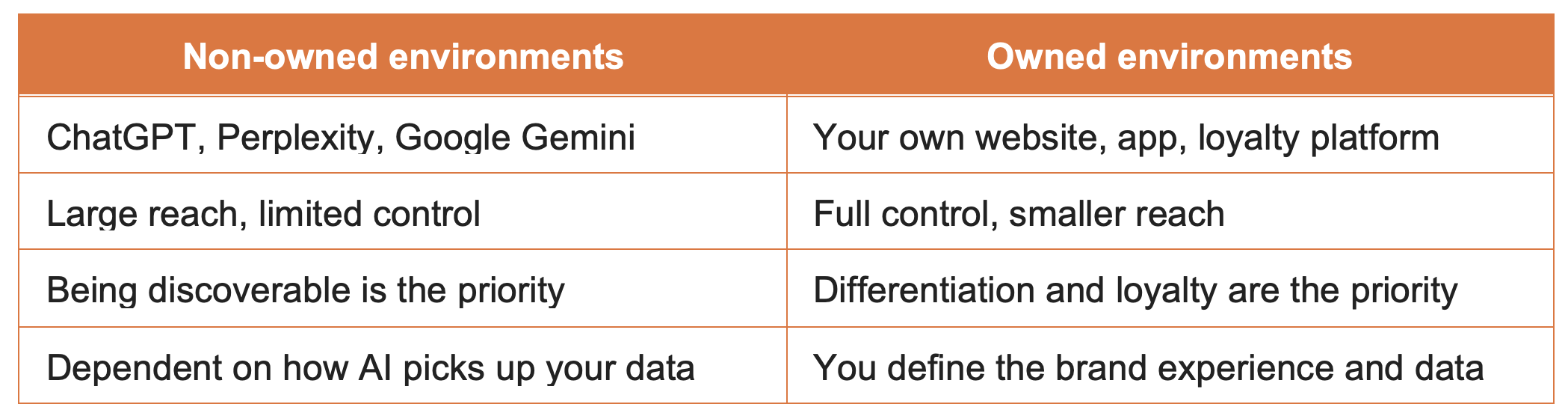
The smartest strategy combines both: ensure you are discoverable and transactional on external AI channels, while simultaneously building a distinctive experience on your own platform.
Do you need to act now?
You are not necessarily behind. But doing nothing is not an option either. Forrester explicitly states that companies who are starting now would do well to lay the foundations first, rather than rushing toward the latest feature. The technology, the protocols and consumer adoption are all still evolving.
But the direction is clear. McKinsey estimates that by 2030, nearly 50% of online shoppers will use AI agents for part of their purchases. In the US alone, this represents $115 billion in additional e-commerce revenue. Globally the opportunity is projected at $3 trillion to $5 trillion. The question is therefore not whether agentic commerce is coming, but when it becomes mainstream, and whether your brand will be ready.
Four questions to start with
– What problem are we solving? Agentic commerce is not a goal in itself. It is a means. Which customer problem or internal inefficiency are you addressing?
– Where is our data? AI agents can only function well when they have access to clean, current and structured data. How is your product catalogue, inventory and pricing organised?
– What about trust? Customers need to be willing to let an AI agent act on their behalf. What guarantees and transparency do you offer?
– What do we build ourselves, and what do we leave to others? Will you invest in your own AI agent, or focus first on visibility in external AI channels?
Conclusion: strategy, not panic
Agentic commerce is real. It is not a trend that will blow over, but a structural shift in the way people discover, compare and buy products. The technology is maturing rapidly, major platforms are investing massively, and consumers are getting used to it.
The most important conclusion for now is simple: understand what it is, follow the developments, and start building the foundation. Clean data, open APIs and a clear strategy. The rest will follow.
Next article in this series
Many companies think they are already ‘agentic’ because they have a chatbot on their website. That misunderstanding is understandable, but also dangerous, because it leads to wrong investments and missed opportunities. In part 2 we explain exactly what the difference is between a chatbot and a real AI agent, why that distinction matters far more than you might think, and how you can assess where your current technology sits on the spectrum from ‘simply automated’ to ‘truly autonomous.’
Part 2 – ‘From chatbot to AI agent: what is the difference and why does it matter?’